
Five VPCs connected by peering need ten peering connections. Ten VPCs need forty-five. Every new VPC means going back into the route tables of every existing VPC to add the new relationship, and every peering connection is a distinct thing that can be misconfigured, forgotten, or left open longer than it should be. That math is the whole argument for hub-and-spoke, and it’s why almost nobody designs a multi-account AWS network as a full peering mesh past the first few accounts.

Part 1 and Part 2 covered the account structure and the guardrails that govern it. This post is about the network underneath: Transit Gateway as the hub almost everyone reaches for, centralized egress and what it costs against the alternative, IPAM (IP Address Management) as the CIDR governance layer, and where VPC Lattice fits without pretending it replaces Transit Gateway wholesale.
Transit Gateway as the hub
AWS Transit Gateway is a managed, regional routing hub. Spokes, VPCs, VPN connections, Direct Connect, attach to it once, and it handles routing between them using its own route tables instead of point-to-point relationships. One Transit Gateway per Region is typically enough since it’s highly available by design, though there’s a legitimate case for more than one where you want to limit the blast radius of a routing misconfiguration or separate control-plane operations between teams. Cross-region connectivity happens through Transit Gateway peering; hybrid connectivity, Direct Connect or VPN, attaches the same way a VPC would.
The account this lives in matters. Transit Gateway, IPAM, and centralized egress infrastructure all belong in the Infrastructure OU’s networking account, sometimes literally called Network or Network Hub, not scattered across workload accounts and not in the Control Tower management account. That account becomes the place a network engineer actually works day to day, and it’s worth treating its own access and change process with the same care as the Security OU from Part 2.
Laid out, the topology looks like this:

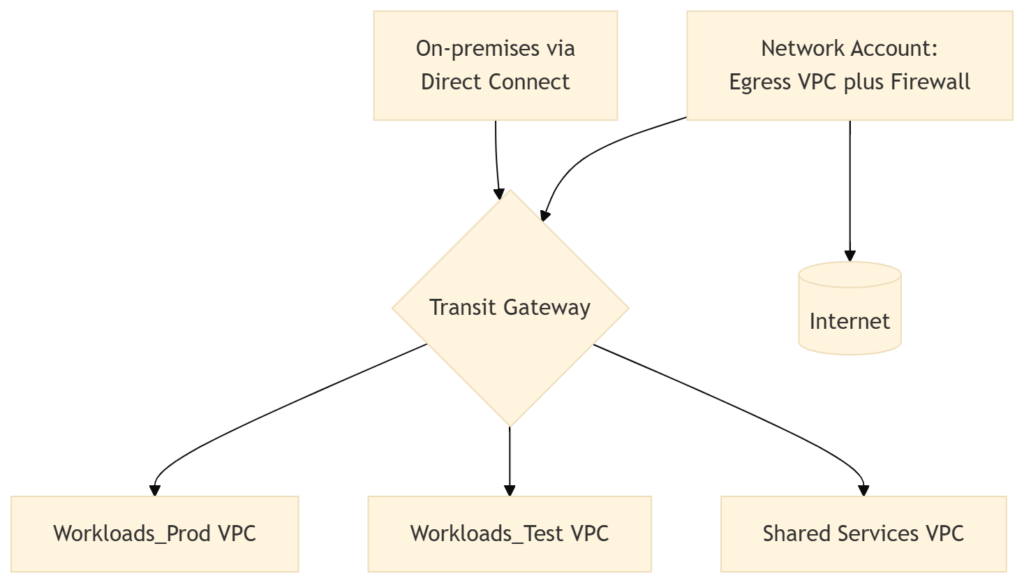
Every spoke VPC gets one attachment to the hub instead of a direct relationship with every other spoke. Whether Prod and Test can actually reach each other is a routing table decision inside the Transit Gateway, not something the topology forces one way or the other, which is exactly the control you lose with a flat peering mesh.
Centralized egress and what it actually costs
The other big reason to centralize on a hub isn’t just routing hygiene, it’s cost. Every VPC that needs internet access wants its own NAT gateway per Availability Zone for resilience, and NAT Gateway data processing charges add up fast once you’re running dozens of VPCs, each with its own pair or trio of gateways running independently. Centralizing egress means routing outbound traffic from every spoke through the Transit Gateway into a single egress VPC in the network account, where it exits through one set of NAT gateways instead of dozens. One practitioner audit found organizations spending around $15,000 a month on NAT Gateway data processing alone, spread thin across VPC after VPC, and cut that by 40 to 70 percent by consolidating.
Adding traffic inspection to that same choke point is a natural next step. AWS Network Firewall sits in the egress VPC and inspects traffic before it reaches the NAT gateway, at a real but bounded cost, roughly $0.40 an hour per endpoint plus a per-gigabyte processing charge, which is a fair trade in a regulated environment and a harder sell if you’re mostly optimizing for spend. One genuine gotcha here: DNS doesn’t follow this path by default. Route 53 Resolver and DNS Firewall are a separate egress route entirely, so centralizing your data-plane egress through Transit Gateway and Network Firewall doesn’t automatically mean your DNS queries are inspected the same way. If DNS-based filtering matters to your threat model, it needs its own explicit design, not an assumption that it rides along with everything else.
IPAM: get the CIDR plan right before account one
IP address planning is one of those things that’s cheap to fix before it exists and expensive to fix after. Amazon VPC IPAM gives you a hierarchical pool structure, a top-level pool subdivided into regional pools, then further into business-unit or environment pools, so that a new VPC in the Workloads_Test OU pulls its CIDR from a pool already guaranteed not to overlap with Prod, Sandbox, or anything else in the organization. IPAM should be delegated to the network account rather than run from the Control Tower management account, the same separation-of-duties instinct as everything else in this series.
The failure mode IPAM prevents is duller than a security incident but just as disruptive: two teams independently pick 10.0.0.0/16 for their VPCs, everything works fine in isolation, and then someone needs to connect the two networks and discovers the ranges collide. Fixing that after the fact means readdressing a live VPC, which is exactly the kind of maintenance window nobody wants to schedule. Getting the CIDR plan right before the first account exists costs an afternoon. Getting it wrong costs a migration.
Route 53 Profiles solve the equivalent problem for DNS. Instead of manually associating private hosted zones, resolver rules, and DNS firewall rule groups to every VPC individually, you bundle them into a single profile in the network account and share it across accounts through AWS RAM. New VPCs associate with the profile once and inherit the whole DNS configuration, rather than someone remembering to wire up each piece by hand every time an account gets vended.
Where VPC Lattice actually fits
VPC Lattice gets pitched sometimes as a Transit Gateway replacement, and that framing oversells it. Transit Gateway operates at Layer 3, it moves packets between IP addresses and doesn’t know or care which identity sent them; security has to come from route tables, security groups, and NACLs. VPC Lattice operates at Layer 7, HTTP, HTTPS, and gRPC specifically, and it’s service-centric rather than network-centric: services register into a service network, consumers discover them by DNS name, and access is governed by IAM policy rather than which subnet you happen to be in. It’s also currently single-region, so it isn’t a drop-in for anything that needs to span regions the way Transit Gateway peering does.
In practice these coexist rather than compete. Transit Gateway keeps doing the job of moving bulk traffic, hybrid connectivity, and anything that isn’t a clean HTTP service call. VPC Lattice picks up new service-to-service communication where IAM-based authorization is a better fit than managing security group rules across account boundaries. I’d reach for Lattice for a new internal API a team wants to expose across accounts without punching new holes in the network layer, not as a project to migrate an existing Transit Gateway backbone onto.
As a decision, it collapses to one real question about the shape of the traffic:

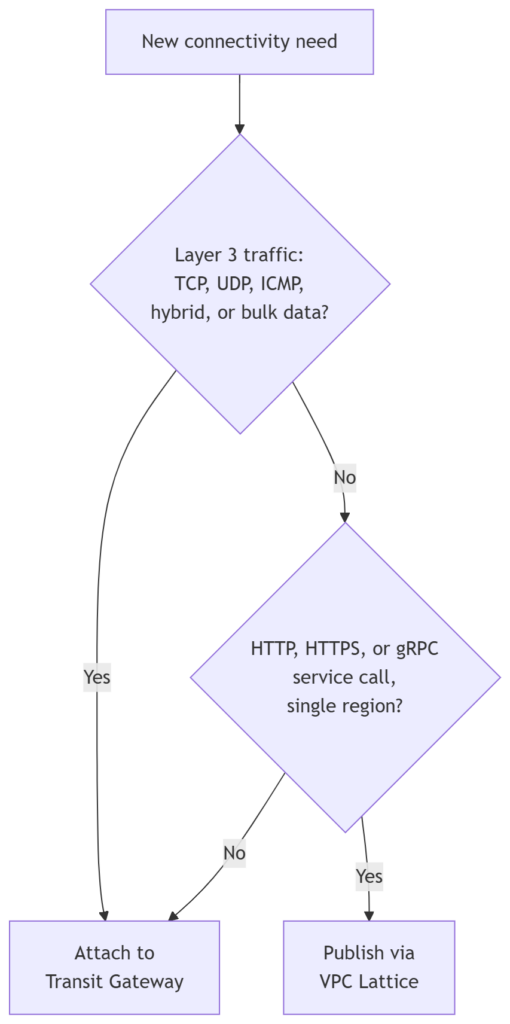
Bulk data, non-HTTP protocols, or anything crossing regions stays on Transit Gateway. A specific, well-defined service boundary within one region is where Lattice earns its keep, and it’s rarely an either-or choice at the level of the whole network.
What’s next
The network is the part of a landing zone that’s genuinely painful to change once workloads depend on it, which is exactly why it deserves the same up-front discipline as the OU structure in Part 1. The last post in this series moves from design to operations: how account vending actually scales once you’re provisioning dozens of accounts a month, why Control Tower can tell you about drift automatically but won’t fix it for you, and the CI/CD pipeline that should sit in front of every change to the guardrails from Part 2 before it reaches a real account.