
There’s a specific error message in AWS Control Tower that ruins a Tuesday. Someone edits or detaches a managed SCP (Service Control Policy) on the Security OU (Organization Unit), and the console locks you out with a warning that the shared accounts may no longer be working, and that you shouldn’t provision new accounts until it’s fixed. AWS documents this exact failure mode in its own knowledge base, which tells you it happens often enough to need a canonical writeup. The lesson isn’t “don’t touch SCPs.” It’s that the guardrails Control Tower manages for you and the guardrails you write yourself live in the same policy type, and mixing them up on the wrong OU is how you find out which one was load-bearing.

This is Part 2 of the landing zone series. Part 1 covered what a landing zone is and the build-vs-buy decision behind Control Tower, LZA, and AFT. This one is about the layer that actually does the enforcing: service control policies and their newer sibling, resource control policies, the logging architecture that has to hold up when an auditor asks for it, and IAM Identity Center as the one door every human uses to get into any of this.
SCPs and RCPs aren’t the same guardrail
It’s worth being precise here because the names invite confusion. A service control policy caps what your own identities, users and roles inside your organization, are allowed to do, regardless of what their IAM policy says. A resource control policy caps who can touch a given resource, an S3 bucket, a KMS key, an SQS queue, and a growing list of others, regardless of what that resource’s own policy allows. AWS puts it simply: use an SCP to limit your own principals, use an RCP to restrict access to your resources from principals outside your organization. Neither one grants anything. Both are ceilings, not floors, and the permission a principal ends up with is whatever’s left after intersecting the SCP, the RCP, and the identity or resource policy underneath.
RCPs are the newer of the two, and they’re moving fast. They launched in November 2024 covering five services: S3, STS, KMS, SQS, and Secrets Manager. Since then AWS has kept extending the list. Cognito and CloudWatch Logs picked up support in January 2026, DynamoDB followed a few weeks later, and the per-organization quota doubled to 2,000 RCPs this past July. That pace tells you something: RCPs are still filling in gaps, not yet the mature, complete tool that SCPs are. Check the current supported-service list before designing a control around a service it doesn’t cover yet.
SCPs got their own significant upgrade in September 2025, when AWS gave them full IAM policy language support: conditions inside Allow statements, individual resource ARNs, NotAction with Allow, wildcards in the middle of an Action string. Before that update, SCPs were noticeably blunter than a regular IAM policy, which pushed a lot of teams toward broad deny-everything-except statements because anything more surgical wasn’t expressible. Existing SCPs kept working unchanged after the update, but if yours predate September 2025, there’s a real case for revisiting them now that more precise allow-with-conditions patterns are possible.
Where these guardrails get scoped
Tie this back to the OU structure from Part 1. In practice, almost every SCP and RCP you write gets attached at the Security OU, the Infrastructure OU, the Workloads OU, or somewhere in between, and the Security OU is the one to treat with real caution. That’s where Control Tower’s own managed SCPs live, the ones protecting the Log Archive and Audit accounts, and it’s exactly the OU where the lockout scenario above happens. If you need custom guardrails for security tooling, write them, but write them as additions at a level below where Control Tower’s own policies sit, not as edits to the managed ones.
Put visually, the two guardrail types gate different paths to the same resource:

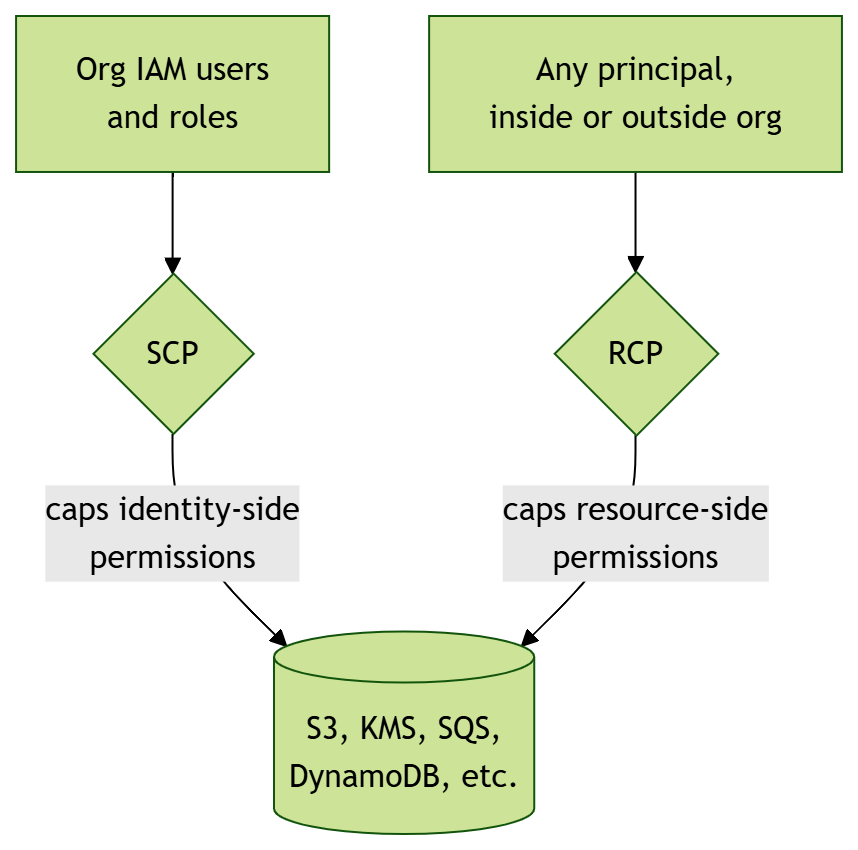
The distinction matters operationally, not just semantically. An SCP written to block a risky action only stops your own users and roles from doing it. If the same S3 bucket is reachable by a principal from another AWS account entirely, only an RCP, or the bucket policy underneath it, actually stops that. Teams that treat SCPs as a complete security boundary and skip RCPs are leaving exactly this gap open, usually without realizing it until an access review turns it up.
Centralized logging that holds up under audit
Control Tower sets up an organization-level CloudTrail trail automatically, which, since landing zone version 3.0, replaced the older model of a separate trail per account. One trail logs everything, management account and every member account, and delivers into an S3 bucket that lives in the Log Archive account, the one nobody logs into day to day. AWS Config runs alongside it, aggregating configuration history into the Audit account rather than Log Archive, a distinction worth remembering when someone asks where a specific piece of evidence actually lives.
The pattern that makes this scale past a handful of accounts is delegated administration. Instead of every security service being manageable only from the management account, you designate a member account, almost always the Audit account, as the delegated admin for GuardDuty, Security Hub, Config, and similar services, and manage all of them centrally from there without ever touching the management account for day-to-day work. This has expanded well beyond security services specifically; one recent count put the number of AWS services supporting delegated administration at 37, up from roughly a dozen when the pattern first appeared. GuardDuty is regional, so this has to be repeated per Region you actually monitor, which is easy to miss if you’ve only ever tested in one.
Here’s what that centralization looks like end to end for a single finding:

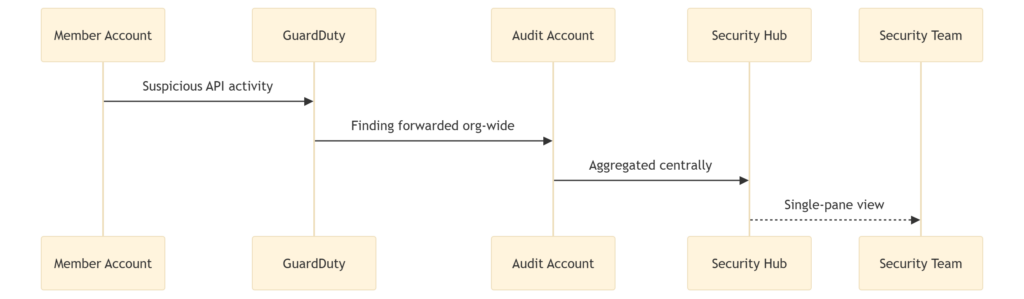
None of this is exotic engineering. It’s mostly turning on the right delegation and pointing things at the Audit account instead of leaving them scattered. The payoff shows up specifically during an audit, when “show me every API call across every account for the last year” is a single query against one bucket instead of a scavenger hunt across forty.
IAM Identity Center as the only door in
Every human touching any of these accounts should be going through IAM Identity Center, not IAM users with long-lived access keys. The mechanics are straightforward: permission sets define what a person can do, assignments connect a permission set to a group and an account or set of accounts, and Identity Center issues short-lived credentials rather than anything standing. Assign to groups, not individuals. When someone changes teams you move the group membership and every downstream permission follows automatically.
Identity Center federates cleanly with an external identity provider over SAML, Okta, Entra ID, whatever your organization already runs, with SCIM (System for Cross-domain Identity Management) handling user and group provisioning so you’re not managing a second identity store by hand. The one thing every landing zone still needs underneath all of this is break-glass access: a small number of IAM roles or users, outside Identity Center entirely, that work even if federation itself is broken or misconfigured. It’s not a contradiction to have SSO for everything and also keep a locked-down emergency path around it. It’s the same reason a building keeps a physical key next to the electronic badge reader.
One detail worth knowing if you’re serious about treating this whole layer as code: permission sets and their assignments can be managed through a CI/CD pipeline just like the SCPs and RCPs above, JSON templates in a repository, a pipeline reacting to changes and pushing updates to Identity Center. It’s a small thing, but it means access changes go through the same review process as everything else instead of being a console click nobody remembers making six months later.
What’s next
Guardrails and identity get most of the attention in landing zone design because they’re where the compliance conversations happen, but the networking layer underneath all of this has its own decisions and its own ways to quietly overspend. Part 3 covers Transit Gateway and the hub-and-spoke pattern almost everyone converges on, centralized egress and what it actually costs against a pile of per-VPC NAT gateways, IPAM as the CIDR governance layer you want in place before account number one, and where VPC Lattice fits next to Transit Gateway instead of replacing it.