
Security teams routinely burn hours triaging a single GuardDuty finding. The workflow is familiar: pull the finding, pivot into CloudTrail, cross-reference VPC flow logs, chase the principal across accounts, map the behavior to a known technique, and finally decide whether the alert is a real incident or noise. Multiply that across an organization producing dozens or hundreds of findings a day, and investigation backlog becomes the bottleneck — not detection.

Amazon GuardDuty is now addressing that bottleneck directly. The GuardDuty investigation is available in public preview and performs on-demand, AI-powered investigations of GuardDuty findings, returning a structured assessment that a human analyst would otherwise assemble by hand.
What changed
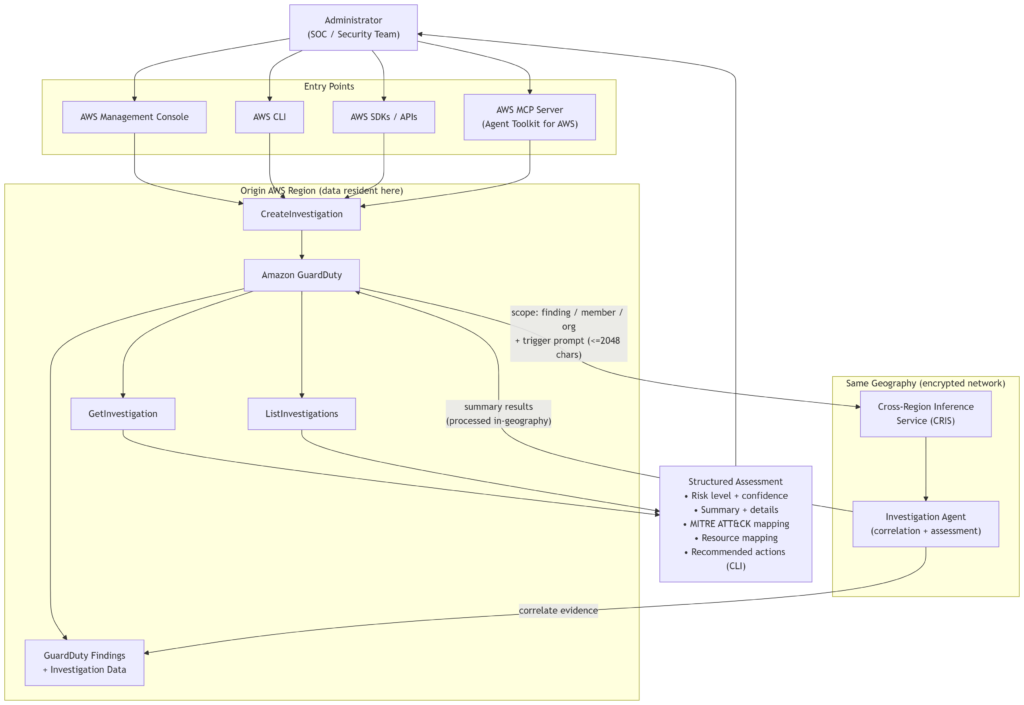
The investigation agent adds a new capability to Amazon GuardDuty: rather than only surfacing findings, GuardDuty can now investigate them for you. Each investigation produces a structured output that includes a risk level, a confidence score, a natural-language summary, investigation details, MITRE ATT&CK technique mappings, resource mappings, and prioritized recommended actions — including specific AWS CLI commands the analyst can execute.
The agent is accessible through the AWS Management Console, the AWS CLI, AWS APIs, AWS SDKs, and the AWS MCP server — meaning it slots into both console-driven workflows and agentic security tooling built on top of the Agent Toolkit for AWS.
How it works
An investigation is initiated by an caller with appropriate permissions through the GuardDuty console, by calling the CreateInvestigation API, or via the AWS CLI. The target can be:
- a specific GuardDuty finding
- a member account
- an entire AWS organization
CLI and API callers can supply a free-form natural-language trigger prompt of up to 2,048 characters to steer the investigation — for example, focusing the agent on a particular hypothesis or scope.
Under the hood, the agent correlates findings and evidence and returns a structured assessment. Results are retrieved with GetInvestigation, and prior investigations can be enumerated with ListInvestigations.
Processing uses cross-Region inference via the Cross-Region Inference Service (CRIS). Investigation data remains stored in the Region where the investigation was created, but inference and summary generation may occur in another Region within the same geography, transmitted over Amazon’s encrypted network.
Please go through this very detailed AWS blog that walks you through the whole investigation process – Amazon GuardDuty investigation agent: on-demand AI-powered threat assessment.
Architecture
The accompanying diagram shows the request flow: an administrator triggers an investigation from the console, CLI, SDK, API, or an MCP-connected agent; GuardDuty accepts the request in the origin Region; CRIS performs inference in-geography; and the structured assessment is returned to the caller while the underlying investigation data stays resident in the origin Region.

When to use it
The investigation agent fits naturally when you want to:
- Triage a single GuardDuty finding without a manual pivot chase
- Assess security posture across an entire AWS organization
- Reduce manual correlation of evidence spread across CloudTrail, VPC flow logs, and other GuardDuty data sources
- Wire GuardDuty investigations into AI-assisted security workflows through the AWS MCP server
- Produce on-demand, structured threat assessments consumable by downstream automation
When not to use it
The agent is not the right tool if:
- GuardDuty is not enabled in the account or organization
- You are operating in a Region that does not support the preview
- You need a member account to view another member’s or the administrator’s investigations, which is not permitted
Security considerations
Architecturally, three points matter for a review.
First, cross-Region inference. Investigation data is stored only in the origin Region, but processing and summary results may traverse another Region in the same geography. If your data-residency posture is scoped to a single Region rather than a geography, this is worth an explicit review before enabling the feature in regulated workloads. Please refer geography and their inference regions here.
Second, transport. Data moves across Amazon’s internal, encrypted network — but the residency point above still stands independently of encryption in transit.
Third, authorization. Investigations honor the existing GuardDuty authorization model. Callers can investigate only accounts they are already authorized to access. The three IAM actions to allow on principals that will drive investigations are:
guardduty:CreateInvestigationguardduty:GetInvestigationguardduty:ListInvestigations
Scope these on the administrator account role that runs the SOC’s investigation workflow, not broadly.
Pricing
In Preview mode, GuardDuty Investigations are made available at free of cost. Confirm current pricing in the GuardDuty product page before enabling at scale once its GA.
Limitations
- The feature is in public preview.
- GuardDuty must already be enabled, the account must be in a supported Region, and only administrator accounts can create investigations in admin as well as member accounts.
- Member accounts cannot access investigations belonging to peer members or to the administrator.
- Cross-Region inference behavior described above also applies.
- During preview, 10 investigations/account/day with total limit of 100 investigations/account.Failed investigations do not count toward these quotas.
- This feature is available only in the following 10 commercial AWS Regions: US East (N. Virginia), US East (Ohio), US West (Oregon), Canada (Central), Europe (Frankfurt), Europe (Ireland), Europe (London), Europe (Paris), Europe (Stockholm), and Asia Pacific (Tokyo).
- The trigger prompt is capped at 2,048 characters when invoked through API/CLI.
Verify latest limitations against the GuardDuty investigation documentation before committing to a design.
Conclusion
The investigation agent shifts GuardDuty from a detection surface to a triage surface. For teams whose incident response cost is dominated by evidence correlation rather than detection, that is the interesting move. Preview status means the mechanics — Regions, quotas, latency, retention — need to be validated against your environment before it lands in a runbook, but the shape of the workflow is clear enough to start piloting against a defined scope, most sensibly a single administrator account or a bounded set of high-signal findings. Details and getting-started guidance are on the AWS Security Blog and in the GuardDuty documentation.