
Splitting a system into cells doesn’t automatically make it resilient. If you still push a bad deployment to every cell at once, or if the same unlucky customer keeps landing on the same overloaded set of cells as everyone else, the isolation on your architecture diagram isn’t doing much for you in production. The pattern only pays off once you pair it with two more things: shuffle sharding, and real discipline about how changes roll out.

Shuffle sharding: spreading the overlap thin
Cells alone reduce blast radius by dividing customers into groups. Shuffle sharding goes a step further by giving each customer (or request) a near-unique combination of cells or nodes, so that any two customers only partially overlap, and the odds of two customers sharing the exact same full set of resources drop fast as your pool of cells grows. AWS describes this in more depth in Shuffle Sharding: Massive and Magical Fault Isolation, and the cell-based architecture FAQ is direct about the boundary: shuffle sharding works within a cell, but by definition a cell shouldn’t share state across cell lines, so don’t let shuffle sharding become an excuse to blur the boundary you just built.
The AZ-as-cell-boundary example from the Journey to Cloud-Native series makes the payoff concrete. With customers shuffle-sharded across three AZ-aligned EKS cells, a black-swan event that would have hit 100 percent of the application without cells is capped at roughly a third of capacity — and shuffle sharding also gives you a scaling lever for a single customer whose traffic spikes unexpectedly, since their load doesn’t have to be absorbed by one fixed cell.
Bake time and fractional deployment
The other half of real resilience is how you ship changes. A cell-based system gives you a natural unit for fractional deployment — roll a change to one cell, watch it, then the next, rather than everywhere at once. What actually makes this work is bake time: a deliberate pause after each incremental step, long enough to know whether the change caused trouble before promoting it further. Depending on the system, that might be fifteen minutes or several hours — the right duration is whatever it takes for you to trust the signal, not a fixed number copied from someone else’s runbook.
The discipline that goes with it is equally important: roll back at the first sign the release is destabilizing things, rather than pushing forward hoping it stabilizes on its own. A fractional failure contained to one cell is a good outcome. A full rollout that later needs a full rollback is the outcome cells were supposed to prevent. Stateful changes deserve extra caution here specifically because they’re harder to walk back — a schema migration that can’t be un-run is a one-way door, cell-based or not.

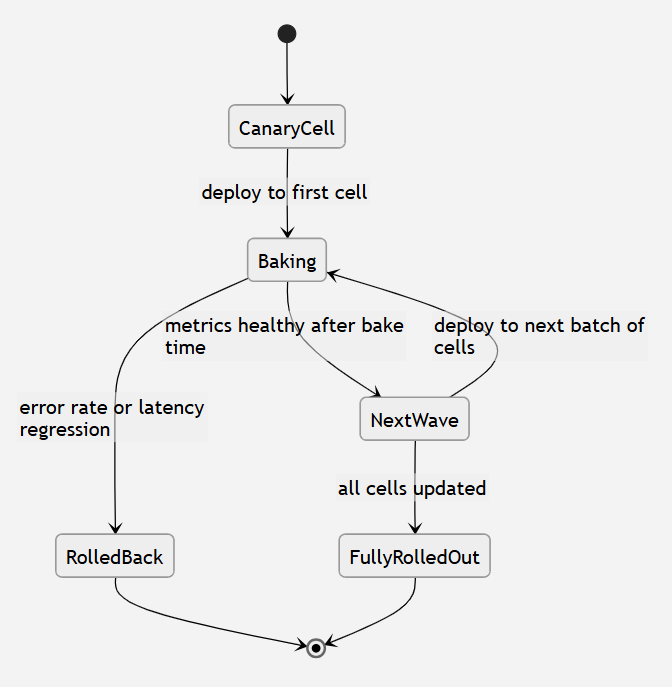
AWS’s own hyperscale teams lean on progressive delivery tooling for exactly this — Argo Rollouts alongside EKS, watching response time and error rate as the promotion signal, described in the same Journey to Cloud-Native post. We’ll come back to wiring this into ArgoCD directly in the last post of this series.
Monitoring: per-cell, and in aggregate
Splitting one system into many cells multiplies your monitoring surface by the same factor. Each cell needs its own health signal — white-box metrics from inside the application, black-box checks from outside it, and business metrics that catch problems the infrastructure metrics miss entirely, like a quiet drop in successful checkouts. On top of that, you need an aggregate view that rolls individual cells up into “how many cells are healthy right now,” because a dashboard with forty individual cell panels and no summary is not a dashboard anyone can act on during an incident.
Tag everything with a cell identifier from the start — logs, traces, and metrics alike — so that when something does go wrong, correlating the failure back to a specific cell is a query, not an investigation. On EKS, Karpenter’s topology spread support and AWS’s Zonal Shift capability are worth pairing with AZ-aligned cells specifically, since they let you push pods away from an impaired zone and cordon affected nodes without hand-rolling that logic yourselves.
Multi-cell transactions: avoid them if you can
Sooner or later someone will ask for a request or a report that needs data from more than one cell. Handle this as a deliberate, external coordination step — a map-reduce-style service that calls each cell through its normal public interface, never by reaching into a cell’s internals directly — and treat every one of these you add as a real complexity cost, not a free feature. Each cross-cell dependency is a small crack in the isolation boundary you built the rest of this architecture to protect. Some are unavoidable. Most are worth pushing back on.
Resilience, in a cell-based system, isn’t a property you get from the architecture diagram. It’s the sum of a routing layer that fails safely, a shuffle-sharding strategy that keeps blast radius genuinely small, and a deployment process that treats bake time as non-negotiable. Get the diagram right and skip the process, and you’ve built an expensive way to still take a full outage. Next in the series: what all of this actually costs, and how it maps onto the Well-Architected Framework beyond just reliability.