By this point in the series you’ve picked a partition key, chosen EKS or ECS as the substrate, worked out the networking, built in shuffle sharding and bake time, and made peace with what it all costs. What’s left is the least glamorous problem and the one that actually determines whether any of the above survives contact with a real team: how do you provision and update dozens of near-identical cells without dozens of near-identical ways for them to drift apart.
Infrastructure as code: the stamp pattern
The core idea is simple to state and easy to get subtly wrong in practice: write one module that describes a cell, and apply it once per cell with different inputs. A hands-on Terraform walkthrough of this pattern frames it as a blueprint you stamp out repeatedly, alongside a separately-built router layer that isn’t part of any individual cell’s module at all.
A minimal shape for that module looks something like this:
module "cell" {
  source   = "./modules/cell"
  for_each = var.cells

  cell_id       = each.key
  account_id    = each.value.account_id
  region        = each.value.region
  az            = each.value.az
  tenant_range  = each.value.tenant_range
}

variable "cells" {
  type = map(object({
    account_id   = string
    region       = string
    az           = string
    tenant_range = string
  }))
}
The detail that matters more than the module code itself is state isolation. Each cell’s Terraform state needs to be genuinely separate — a distinct backend key per cell, not just a shared workspace inside one state file — so that a plan or apply against cell-07 can’t accidentally touch cell-03. A shared state file for “all cells” quietly reintroduces exactly the coupling the whole architecture exists to avoid, just at the tooling layer instead of the runtime layer.
CDK works the same way conceptually, even though the syntax differs. AWS’s own reference implementation structures this as three separate stacks — one for shared ECR repositories, one for the routing components, and one for the cell blueprint, which gets deployed repeatedly, once per cell. Terraform, CDK, or CloudFormation, the stamp pattern is the same idea wearing different clothes.
A cell registry as the single source of truth
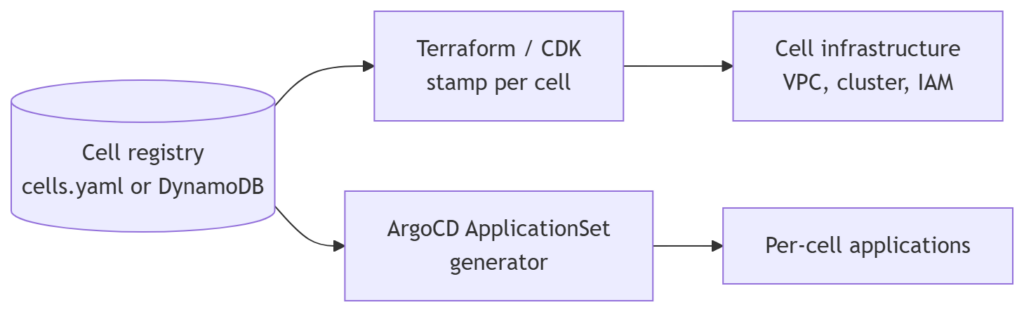
Once you’re past a handful of cells, you want one place that lists every cell that exists — its account, region, AZ, tenant range, and lifecycle status (active, draining, newly provisioned). This can be as simple as a cells.yaml checked into the same repo as your Terraform, or as robust as a DynamoDB table if other systems need to query it at runtime. What matters isn’t the storage mechanism, it’s that this registry becomes the one input that drives both your infrastructure provisioning and your application deployment generator — because the moment those two read from different sources of truth, you’ve created a gap where they can disagree about how many cells exist.
Deploying applications with ArgoCD
On the application side, ArgoCD’s ApplicationSet controller is built for exactly this fan-out. A list or git-file generator, sourced from the same cell registry, produces one child Application per cell (or per cell-and-app combination), rather than hand-maintaining one YAML file per cell per application.
apiVersion: argoproj.io/v1alpha1
kind: ApplicationSet
metadata:
  name: order-service-cells
  namespace: argocd
spec:
  generators:
    - git:
        repoURL: https://github.com/your-org/gitops-cells.git
        revision: main
        files:
          - path: "cells/*/registry.yaml"
  template:
    metadata:
      name: 'order-service-{{cell_id}}'
    spec:
      project: order-service
      destination:
        server: '{{cluster_endpoint}}'
        namespace: order-service
      source:
        repoURL: https://github.com/your-org/gitops-cells.git
        targetRevision: main
        path: 'apps/order-service/overlays/{{cell_id}}'
Platform-wide baseline components — an ingress controller, cert-manager, the monitoring agents every cell needs regardless of tenant — are a good fit for a separate App-of-Apps hierarchy, kept distinct from the per-cell, per-tenant applications so a change to the shared baseline doesn’t get tangled up with a single cell’s release train.
Sync waves are worth using deliberately here: router configuration and any cell-registration step should land before the cell’s own workloads sync, not after, or you risk a cell coming online with traffic already routed to it before its services exist. And each cell’s rollout should carry its own canary and bake time — tying back to the deployment discipline from earlier in this series — rather than one canary standing in for the whole fleet. A fleet-wide canary defeats the purpose of having cells in the first place; the point was that a bad release only ever touches one of them at a time.
The habit that actually keeps this from falling apart
None of this tooling prevents drift on its own. What prevents drift is treating the cell registry as a change that goes through the same pull request and review path as any other production change, and making sure both the Terraform plan and the ArgoCD ApplicationSet read from that same file. When someone adds cell-12 to the registry, that one commit should be the trigger for both the infrastructure to get stamped out and the applications to start deploying into it — not two separate manual steps that someone has to remember to keep in sync.
That’s really the throughline of this whole series. Cell-based architecture starts as a resiliency idea — smaller blast radius, contained failure — but by the time it’s running in production it’s mostly a delivery-engineering discipline. The isolation only holds up if your pipeline can safely stamp out cell N+1 in an afternoon, deploy into it with the same confidence as cell N, and tear it down just as cleanly if it turns out you didn’t need it. If your tooling can’t do that yet, the resilience story is still theoretical — and that’s a good place to start the next iteration of the design, rather than the last one.
Share Your Comments & Feedback: